
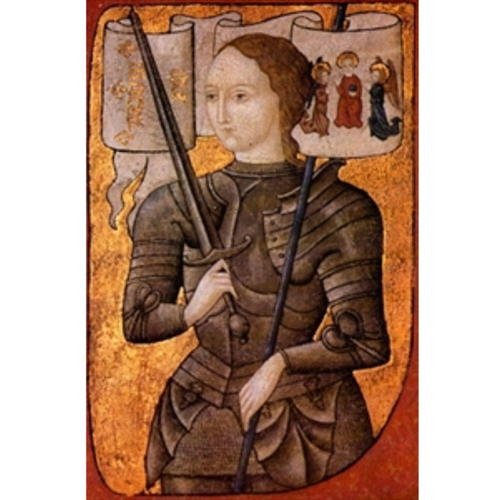
The Girl Who Heard a Voice and Changed History.
Joan of Arc was a teenage girl from France who became a military leader, a symbol of national pride, and one of the most fascinating figures in world history. She sets an incredible example for young women around the world.
As one of the first recorded examples of young women challenging gender roles, she took up space in a male-dominated world and refused to back down, even when her life was on the line. This is what courage looks like. Not because she was perfect. But because she followed her convictions, even when the cost was high.
Who Was Joan of Arc?
Joan of Arc didn’t come from a royal family. She was an ordinary farm girl who couldn’t read or write. But her life became extraordinary: from peasant girl to visionary, warrior, martyr, and later saint. She was born around 1412 in Domrémy, a small village in north-east France, and died May 30, 1431, aged 19, and is also known as the Maid of Orléans.
What Was Happening in France at the Time?
To understand Joan’s story, we need to know about the Hundred Years’ War (1337–1453). It was a long and complicated war between France and England over who should be the king of France.
By the time Joan was a teenager,
- The French were losing badly.
- Parts of France were under English control.
- The French crown prince (called the Dauphin) had not yet been crowned king.
- People were tired, poor, and scared.
France was desperate for hope and for a hero.
Joan’s Vision: A Voice That Changed Everything
At age 13, this young girl said she began hearing voices. She believed these voices were sent from God. They came from saints. Saint Michael, Saint Catherine, and Saint Margaret.
The message was that she was chosen to save France. Joan believed it, and she convinced others to believe it too.
A Young Woman Goes to War
By age 17, Joan had made her way to the Dauphin (Charles), and after some questioning and testing, he allowed her to join the army.
Today, I don’t think we understand just how radical this was. In those days:
- Women were not allowed to fight in wars.
- She dressed in male military clothing and armour.
- She cut her hair short and behaved like a soldier.
- Many people thought it was unnatural or wrong, but she did it anyway.
The French army won a major battle at Orléans in 1429 with this young woman at the front, and it was a turning point in the war.
Later that year, Charles was crowned King Charles VII, and Joan was right there beside him. She had fulfilled the first part of her mission.
Why Did People Follow Her?
It’s important to remember Joan wasn’t trained in politics or war and was just a young girl who didn’t come from wealth or power. But she had:
- Deep belief in her mission
- Powerful charisma
- Religious authority (people saw her as chosen by God)
- A bold, fearless spirit
- The ability to inspire hope at a time when France had almost none
Whether people believed her visions or not, they couldn’t ignore her.
Joan’s Arrest and Trial
After some continued military campaigns, Joan was eventually captured by the Burgundians (French allies of the English) in 1430. She was sold to the English and put on trial.
Her charges were not military. They were religious and political.
She was accused of
- Heresy (speaking against the church)
- Witchcraft (because of her visions)
- Wearing men’s clothing (yes, this was actually a major crime at the time)
The real reason was that the English wanted to destroy her reputation. If she wasn’t truly sent by God, then maybe the French king didn’t deserve the crown after all.
Joan was put on trial by church leaders controlled by the English, not an impartial court.
Despite being only 19 years old, Joan stood her ground through weeks of questioning. She refused to lie, even when it could have saved her life.
Eventually, she was found guilty and sentenced to death.
Joan’s Death and Legacy
On May 30, 1431, Joan was burned at the stake in the town of Rouen, France.
Her final word was “Jesus.”
She died at 19, accused of being a heretic.
But 25 years later, that verdict was reversed. She was declared innocent.
In 1920, the Catholic Church declared her a saint.
Today, Joan is
- A national hero of France
- A symbol of faith, bravery, and independence
- Celebrated every May 30 in France and other parts of the world
- Seen as a feminist icon by many for stepping into a male world and refusing to be silenced
This young woman is more than a historical figure. She’s a symbol.
Her life raises important questions:
- What does it mean to trust yourself when no one else does?
- What happens when a young woman claims power in a world built to exclude her?
- How do people react when someone doesn’t follow the rules, especially rules about gender?
Joan challenged every expectation placed on her.
- She wore what she needed to do her job, even if it broke laws.
- She believed her voice mattered, even when religious leaders told her it didn’t.
- She became a leader, even though she had no formal title or training.
She made people uncomfortable. And that’s often what change-makers do.
She remains one of the most famous women in history—respected across cultures and religions.
Final Thoughts
Joan of Arc’s story reminds us that courage doesn’t always come from strength.
Sometimes, it comes from listening to your inner voice and acting on it, no matter who doubts you.
Sometimes, the young women who break the rules are the ones who end up changing the world.
0 Comments